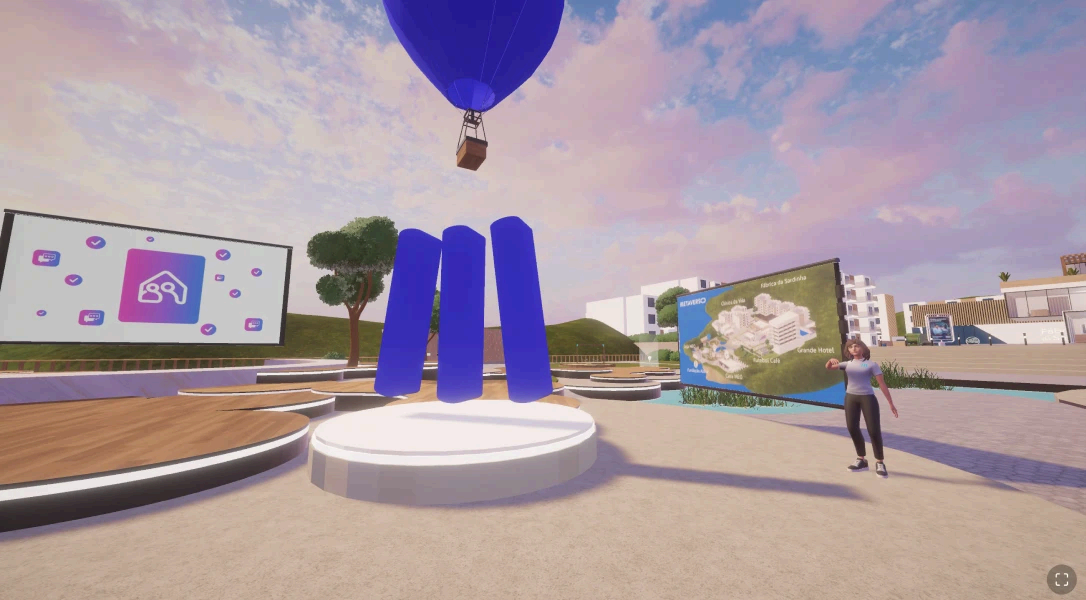
MEO Metaverso
Role
Lead Designer & Developper
Company
Instinct x MEO · Cascais & Lisbon
Year
2023
Tools
Built and scaled MEO's metaverse across 3 major iterations, from solo execution to directing a 3D designer and a game developer. Covered UX, UI, 3D modeling, Unity development, spatial signage, branding and social media content. Built on Spatial.io with the Portuguese innovation agency Instinct, the project grew from a single virtual space into a full multi-environment ecosystem, hosting live events, brand activations, interactive museums and product experiences over two years.
01
Challenge
The brief was ambitious: create a virtual environment that felt like MEO, not a tech demo. It had to work across PC, smartphones, tablets and VR headsets (Meta Quest 2 & 3), attract both existing customers and new audiences, and serve as a live platform for ongoing campaigns and partnerships. Beyond the creative challenge, this was a new medium. There were no established UX patterns for spatial navigation at this scale. We were figuring it out as we built it.
02
Choosing the Stack
Before designing anything, I spent the opening weeks sourcing and benchmarking the platforms available. Where to build was the design constraint that would shape every other one, team size, learning curves, content workflow, device compatibility, lifespan. It wasn't a tech choice, it was the first design decision of the project.
The candidates evaluated. Decentraland, Roblox, Fortnite Creative, VRChat, Spatial.io. Each was tested against MEO's actual constraints, not against the 2022 metaverse hype. Decentraland and Web3-native platforms were too crypto-coupled for a mainstream telecom audience. Roblox and Fortnite Creative had massive reach but locked us into their aesthetic and governance, it couldn't have felt like MEO. VRChat was strong on the social side but assumed a headset-first audience MEO didn't have.
The two criteria that decided it. Accessibility: MEO's audience was smartphone first, not VR. Spatial.io ran in the browser, one click, no install, no friction. Scalability: V1 was solo, V2 and V3 would need a team. Spatial.io's pipeline, built on Unity under the hood with Blender as the asset entry point, used industry-standard tools rather than a proprietary editor.
The compromise I accepted openly. Spatial.io capped each instance at 50 concurrent users with automatic world duplication beyond that. For a true mass-event metaverse that would have been disqualifying. For MEO's actual use cases (B2B meetings, brand activations, product showrooms, scheduled performances), the audience naturally distributed across instances and the duplication was invisible to users.
03
Timeline & Iterations
V1, July to December 2022, solo execution. Launched the core MEO Place ecosystem: a Central Plaza as the main hub, a Virtual MEO Store with avatar-based assistants and live promotions, an Amphitheater for virtual events. A second map introduced Casa MEO, a fully furnished virtual house showcasing smart home products from MEO's real store, with family and salesperson avatars simulating a real shopping context.
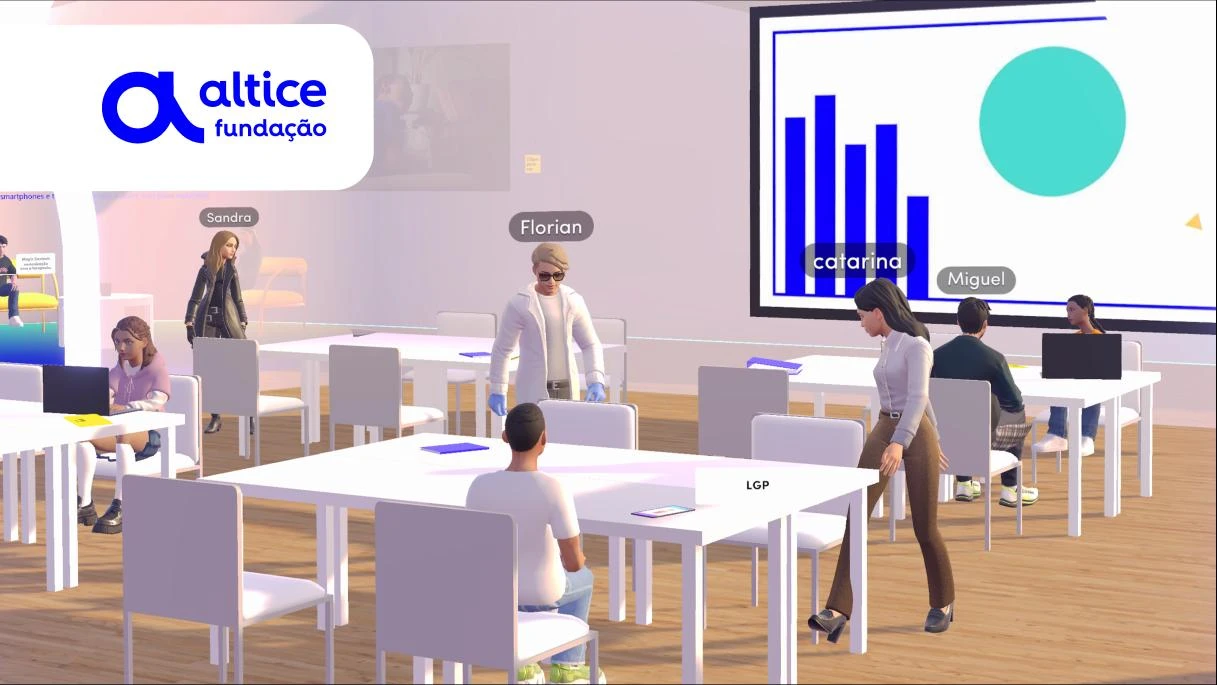
V2, December 2022 to July 2023, with one 3D designer. Shifted from a static launch to a living platform. Seasonal campaigns synchronized between IRL and metaverse (Christmas, Valentine's, Easter). Expanded with MEO Empresas, a dedicated B2B space featuring meeting rooms and buildings presenting MEO's professional solutions across healthcare, hospitality, and enterprise. Two additional spaces for the Altice Foundation: one focused on accessibility for children with disabilities, one as an interactive museum with multi-language support and three content modes (Kids, Adult, Simplified).
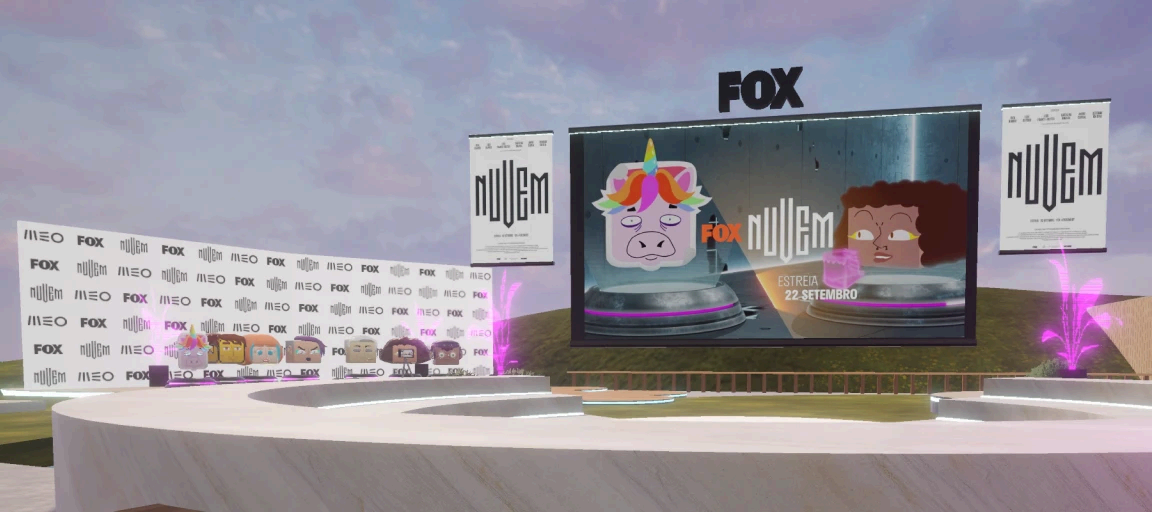
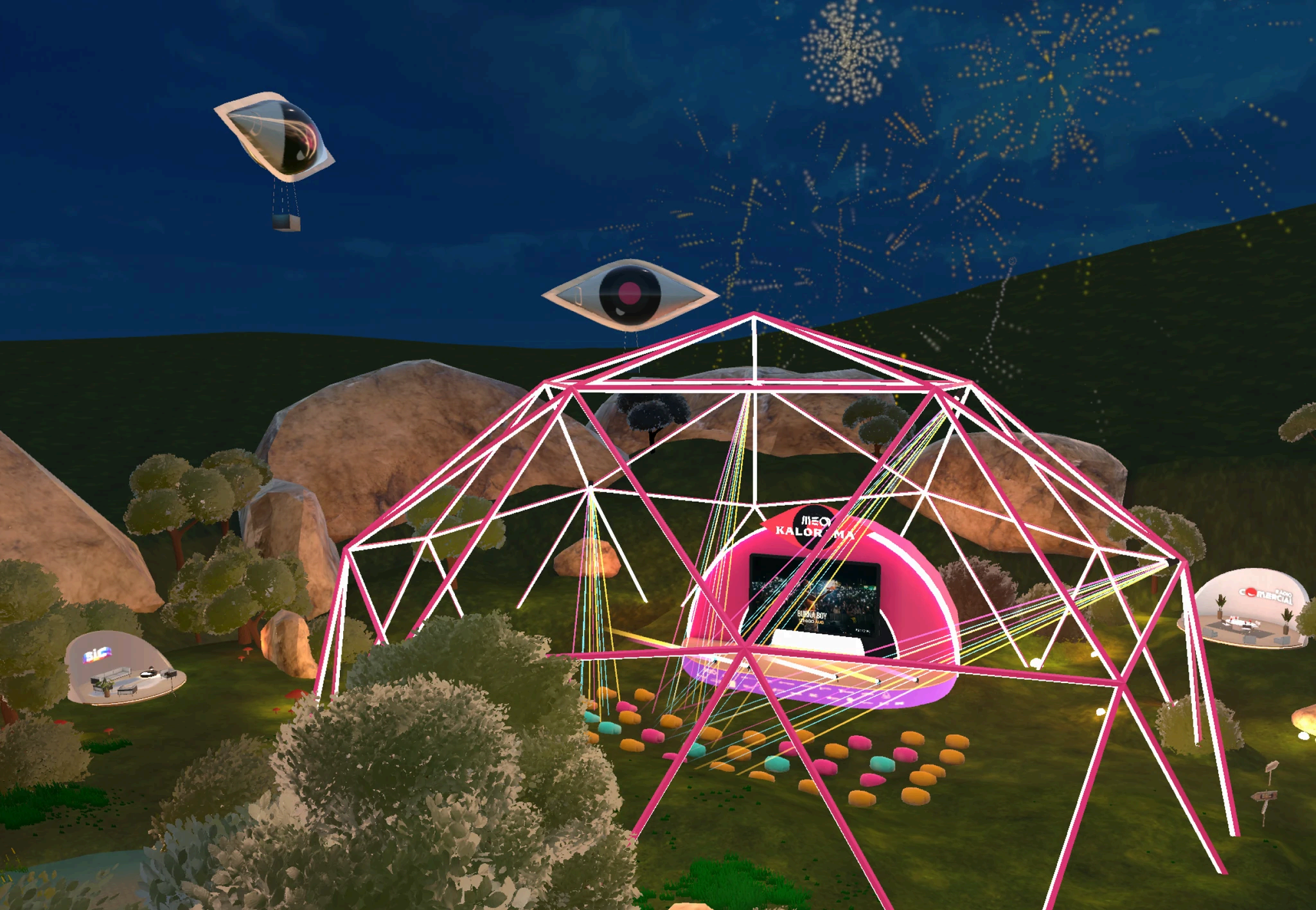
V3, July 2023 to 2024, with one 3D designer and one game developer. Elevated the platform's technical ambitions. Delivered the FOX & Disney Portugal NUVEM activation, a live show with actors performing inside the metaverse. Broadcast the MEO Kalorama music festival live and hosted a press conference in the metaverse. Built A Fábrica de Sardinhas MEO, a quest-based scenario where users explore a sardine factory to discover MEO's cybersecurity solutions through interactive storytelling.
04
From Digital Product to National Brand Activation
The metaverse didn't stay digital. Within months of V1's launch, dedicated MEO Metaverso discovery stands were deployed across MEO's flagship stores, the largest locations in Lisbon, Porto, and other major cities, equipped with Meta Quest 2 headsets, branded signage, and staff briefed to onboard customers into the virtual experience on the spot. Around the rollout, MEO ran a national campaign: TV spots, full-wrap city buses, social and in-store video, visual content I designed in-house and handed off to MEO's retail agency for physical production.
This shifted the project's scope entirely. What had been designed as a browser-first metaverse became the anchor of a phygital brand experience: a customer could walk into a flagship store, try the Quest 2 at the discovery stand, enter a virtual version of a MEO Store, and complete an actual purchase through the deep-link bridge back to MEO's real e-commerce. The store sold the metaverse. The metaverse sold the store.
Beyond the platform itself, I produced the visual system that carried MEO Metaverso into the physical world: logo, key visuals, in-store posters, 3D avatars for the stand demos, social content, and the video assets used in the TV and city-bus campaign. The brand experience stayed coherent from the TV spot to the headset on the customer's face, same avatars, same color system, same atmosphere.
05
Deep Dive · Designing Spatial Signage
In V1, users dropped into the Central Plaza and just stood there. Or wandered. Internal playtests showed something I hadn't expected: in a first-person 3D environment, users don't read the space the way they read a webpage. They turn their head, get disoriented, and either commit to one direction at random or freeze. Whole zones of the map were missed entirely. This wasn't a visual hierarchy problem in the 2D sense. It was a wayfinding problem in the architectural sense.
Three directions explored. A, persistent UI overlay (the GPS approach): a minimap pinned to the corner, users stopped looking at the world, presence collapsed. Killed. B, avatar guides (the concierge approach): NPCs scripted to greet users and point them toward zones. It worked but didn't scale. C, environmental signage (the architectural approach): treat the metaverse like a real public space, airports, museums, shopping centers, where wayfinding lives inside the architecture itself.
Why C won. It preserved presence, the user's attention stayed in the world. It scaled, a signage system is a reusable language, not a per-space asset. And it gave each MEO space a sense of place, visitors started describing zones like physical locations.
What we shipped. A spatial signage system with four layers, applied consistently across every MEO space from V1 onward: landmark architecture so each zone has a visually distinctive structure visible from the spawn point, suspended floor markings and directional signs at decision points, ambient lighting cues that draw the eye toward zone entrances, and a unified iconography so the language reads the same in any environment.
06
Bets That Didn't Pay Off · The Web3 Layer
A two-year project in an emerging medium can't be told honestly without naming what we tried that didn't work. The most expensive bet, both financially and in attention, was the Web3 layer.
At the start of the project, I built the Web3 thesis and the case for acquiring ETH and reserving a portfolio of .eth domains for MEO Metaverso, securing them for several years ahead. The case was presented and approved at the board level. The thesis assumed that crypto-native identity, wallet-based access, and tokenized assets would become a standard layer of branded metaverses by 2024.
That assumption didn't survive contact with MEO's actual audience. Mainstream telecom customers had no interest in wallets, no patience for seed phrases, and the broader crypto winter killed any momentum the layer might have had. The .eth domains were quietly held, never activated as a user-facing feature. The lesson wasn't that Web3 was wrong, it was that betting on adoption timelines in an emerging medium is a forecasting problem, not a design one. We absorbed the cost, documented the call, and reallocated the attention to the spatial signage and brand activation work that did move the needle.
07
The Other Three UX Challenges, Briefly
Interactions were invisible. Users couldn't tell what was interactive versus decorative. Engagement on interactive objects was near zero in V1. Solution: proximity-based triggers, interactions activate automatically when users enter a defined radius. Replaced find-and-click with spatial discovery.
Large spaces had no navigation shortcut. As the ecosystem grew, moving between spaces became friction and users abandoned before exploring. Solution: an interactive map with teleportation, full environment at a glance, direct jump to any space.
Virtual products had no path to purchase. The MEO Store showcased products in 3D with no connection to MEO's real e-commerce. Solution: product deep links connecting 3D items to their pages in MEO's online store, examination in 3D, checkout in the actual e-commerce.
First telecom operator in Portugal to launch a metaverse presence
Bronze Award M&P Criatividade 2023
Attracted audiences beyond MEO's traditional customer base
Platform extended from Lisbon to Porto following V1 success
Hosted activations for Disney Portugal, FOX, Kalorama Festival, Altice Foundation
Scaled from solo project to a coordinated 3-person creative team across 2 years